Gametype — a game IDE for the Mac · Public beta
Describe a game.
Play it a minute later.
Gametype is a Mac app for making real games by talking to it. Say what you want and it builds the change in a real game project, runs the game to check its own work, and hands it back for you to try. No experience needed — and every line of code is still yours to open.
One account, one monthly AI credit balance across Ekko, Illustrate, Ledgerly and Gametype. Free includes 50 credits a month. Monthly credits renew without rolling over; purchased top-ups never expire and are used after your monthly credits.
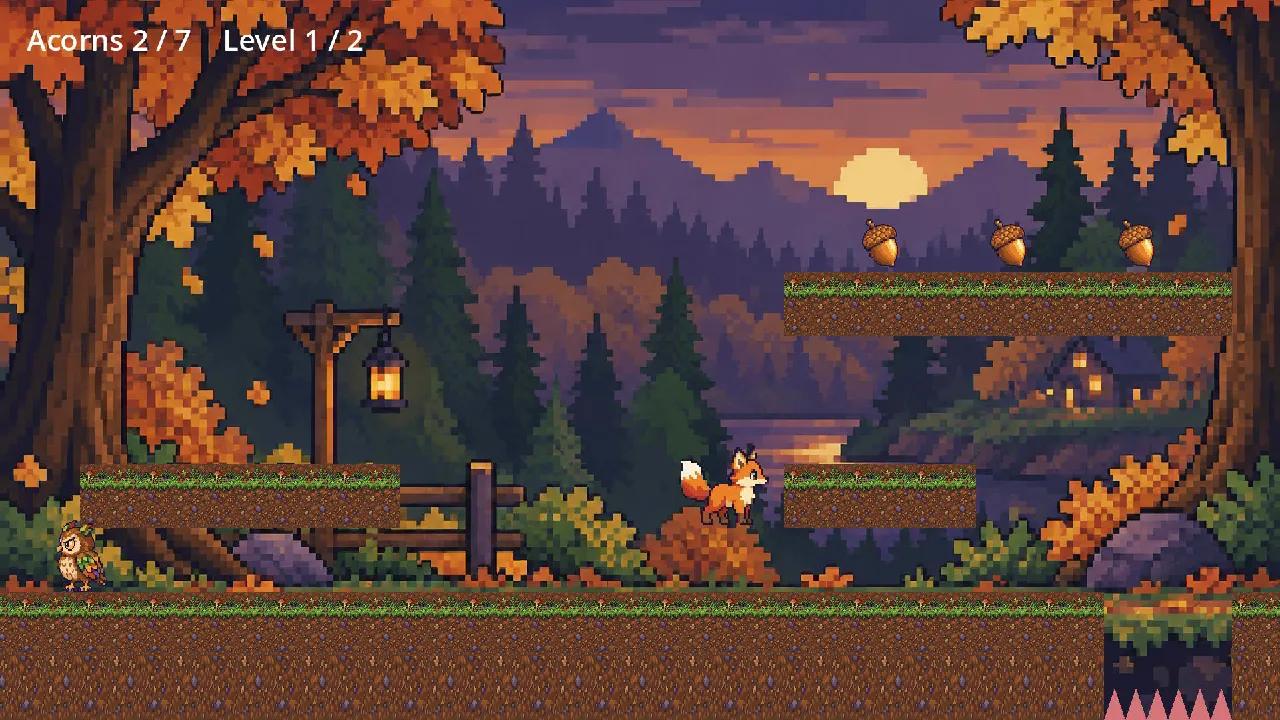
Acorn: the platformer template with art from Gametype in one locked style, recorded as it plays. The panel beside it is an example run.
One change, start to finish
It does the work. You keep the decision.
Four steps, every time, whether the request is a longer dash or a whole boss level.
- 01
Say what you want
“Add a double jump.” “Make the boss harder after the second hit.” Plain sentences, typed or spoken, about the game in front of you rather than the code behind it.
- 02
It builds on a copy
Fast models write the change against a copy of your project, never the one you are playing. Scenes, scripts and assets, in the files the engine already expects.
- 03
It runs the game to check
The engine opens the project and plays the scene. If the check fails, a frontier model reviews the work and fixes it before you ever see it — and you can ask for that review on any change.
- 04
You keep it or undo it
The diff, the files and the running game arrive together. Nothing touches the project you are playing until you say keep.
Everything a first game needs, in one window.
Project editing, PNG generation, playtesting and exports in one app. Bring in 3D and audio assets from external tools when your game needs them.
Five games that already play
Platformer, top-down adventure, arena shooter, endless runner, box puzzle — each with gameplay and an objective — or a blank project that starts as a movable square. All of them are 2D.
Bots that play it dozens of times
The playtest lab runs your 2D game again and again and counts what happened: who finished, where they died, where they got stuck. Every finding carries the evidence it was drawn from and a request the agent can act on.
Art in your game’s own style
Heroes, enemies, walk cycles, tiles and backgrounds drawn against a style you lock once. Or bring art in from public asset libraries and your marketplace purchases — its licence is recorded with it.
A project you can open anywhere
Scenes, nodes and plain script files, laid out the way the engine lays them out — a standard layout, not one of ours. Open it in the editor whenever you like, keep it in your own git, and leave whenever you want; there is nothing proprietary to get out of.
Ships where the engine ships
Desktop, mobile and the browser, built by the engine’s own exporter on a copy of the project. The web build is ready for a browser-game host.
Say it out loud while it runs
Speech is recognised on your Mac rather than sent anywhere. A tweak it can resolve exactly — “make the dash shorter”, “set speed to 300” — is applied on the spot and undone just as fast; anything larger becomes a request to the agent.
We are drawing packs of our own, and they will appear in the asset store: bought on the web, added from the app in a click, with the licence recorded against your project.
Credits pay for the models. Nothing else costs anything.
See the plansA credit is model time — the writing and the reviewing that a request sets off, priced from what the models actually charged for it. It is the one part of making a game here that is not happening on your own computer, so it is the one part there is a bill for.
Measured on a real game, most changes cost 1–3 credits; one the stronger model has to review costs about 11. Gametype is for making a game without writing the code. If you already program, an editor with an AI assistant gives you more model time for the money.
If you would rather pay for models yourself, add your own AI gateway key in Preferences: requests are billed to it at list price and spend no credits. And the workspace has a real terminal in your project, so the coding tools you already use run beside it.
Free to start
Every account gets an allowance of credits each month without a card. It is enough to build a small game and see whether you like the way it works.
Only models cost
Running the game, editing it, playtesting it and exporting it all happen on your own machine, and none of it draws a credit.
Nothing is spent unseen
Choose a credit limit before each run. It covers model calls and generated images; requests stop before their maximum charge would exceed the remaining limit. Actual usage appears with the run, and final billing may settle afterward.
What you need
A Mac
macOS 14.0 or later, Apple silicon or Intel. The app itself runs on Mac; the games you make export to Windows, Linux and the web.
Godot 4
Free and open source, from godotengine.org. Gametype drives the copy you install; it never hides it from you.
An account
One Temp & Major account, paired to the app with a code it shows you. The free plan needs no card.
Get the app
Open the Apple menu → About This Mac to see which one you need.
Version 0.1.3
What it is not
A walled garden
Your game is an ordinary project in a folder you chose.
A AAA pipeline
This is for 2D and simple 3D games made by one person or a few.
A storefront
We do not host your game and take no cut of anything you sell.
A console toolchain
No public tool can build for PlayStation, Xbox or Switch; the app tells you which programme to apply to instead.
Unattended
A big change can take more than one run, and bots find where a game is unfair — not whether it is fun.